24.09.2026
Automating processes with AI: Step by step with linqi
Automating processes with AI: A simple step-by-step guide to automating your workflows with AI – using linqi as an example.

A recent study shows that many tech start-ups avoid the public sector as a client because bureaucracy, lengthy procedures and a lack of flexibility make collaboration difficult. This makes it all the more important for the public sector to drive its own digitalisation forward. With linqi, departments can implement processes as digital workflows without any programming – step by step, closely aligned with day-to-day work and without having to wait for a single, comprehensive solution from outside the organisation.
It’s no secret: the public sector has an enormous need for digitalisation and therefore actually offers the ideal conditions to be an attractive client for innovative companies. In theory, at least. Yet despite this, many start-ups shy away from working with the public sector.
The GovTech Start-up Monitor 2026, published by the Start-up Association and Accenture in cooperation with the Centre for Digital Governance at the Hertie School, reveals that only 11 per cent of the approximately 220 founders surveyed consider working with the public sector to be more attractive than working with the private sector. Among other things, a high level of bureaucracy is cited as an obstacle. The system is described as very risk-averse and, as a result, less focused on innovation.
The survey raises an uncomfortable question: if even companies whose business model is based on innovation, speed and new technologies are reluctant to collaborate with public authorities – who, then, will drive the digitalisation of public administration?
Digitalisation doesn’t have to wait for an external provider to deliver the perfect all-in-one solution. Public administration can take the first step itself. Administrative staff need neither learn to code nor manage complex IT projects on the side. With linqi, they are given tools that allow them to translate their specialist knowledge directly into functioning digital processes.
Because that is exactly what linqi is designed for: As a no-code platform, linqi enables forms, responsibilities, validation steps, approvals and documentation to be linked into digital workflows – without any programming, simply via drag-and-drop. In doing so, linqi clears several hurdles on the path to digitalisation. But what exactly are these in detail?
Digital administration in Germany is often viewed as a major technical project. In day-to-day practice, however, it is usually a series of smaller hurdles that reinforce one another. If you look at them individually, it quickly becomes clear that many of the problems associated with digitalisation can be solved more pragmatically than they initially appear.
In many public authorities, digitalisation is still automatically regarded as the responsibility of the IT department. This leads to long queues: specialist departments report a need, the requirements are collated, budgets are requested, service providers are sought and deadlines are agreed. Months go by. Small improvements thus turn into protracted projects – or are never even started.
Yet it is the staff in the specialist departments who know their processes best. They know which documents are regularly missing, where queries arise, which approvals are held up, and why an Excel spreadsheet is maintained alongside the official procedure.
With linqi’s no-code principle, specialist departments can digitally model and customise their workflows using pre-built modules. IT remains vital for architecture, security and interfaces, but is no longer required for every change to a form or process step.
This gives the administration greater flexibility and autonomy – whilst system security remains in the hands of the IT department with minimal risk.
Another typical obstacle to digitalisation is the desire to solve everything at once: the new citizen portal, the complete e-file, a standardised specialist procedure and seamless collaboration across all departments.
The aim is the right one. However, the starting point is often too vague. A modern public administration emerges when specific processes gradually become better – and more digital. A sensible starting point could be, for example, the processing of applications for special use permits. Once that process is in place, you can move on to the next one that is frequently repeated and takes up a lot of time and effort.
Instead of dealing with applications, email coordination, Excel spreadsheets, printouts and scans, linqi integrates receipt, technical review, comments from other departments, deadlines and documentation into a single workflow.
The process remains manageable, the benefits become apparent quickly, and the building blocks gained can be reused time and again for similar procedures. In this way, a single digitised process gradually evolves into a sustainable digital transformation of public administration.
Digitalisation in public authorities rarely starts from scratch. In most cases, specialist procedures, document management systems, portals, registers, email inboxes and custom spreadsheets are already in place. Each system serves a purpose – but there is often a lack of connection between them.
Media breaks are then a nuisance that costs time every day: data is copied, documents are filed multiple times, status information is requested via email, and decisions are transferred manually. These are not spectacular problems associated with digitisation. They cause unnecessary effort and increase the likelihood of errors.
linqi integrates existing systems into shared workflows via interfaces. The platform does not, therefore, replace existing business processes. Rather, it coordinates the steps between them: Who checks the process? Which data is transferred? When is a deadline triggered? Where is the decision documented?
In this way, several individual solutions are transformed into a transparent end-to-end process. Departments can continue to work with familiar applications, whilst information is transferred between systems in a controlled manner.
There is no question that high standards of data protection, information security, audit trails and legal compliance are indispensable in public administration. The problem arises when these are treated not as design requirements, but as a blanket argument against change.
Paper, email and local lists are not automatically more secure simply because they are familiar. Unclear access rights, duplicate data sets and processing steps that are difficult to trace can create additional risks.
With linqi, authorisations, responsibilities, processing statuses and documentation can be mapped in a structured manner. Processes become fully traceable, whilst processing takes place in compliance with the GDPR at a German, ISO 27001-certified data centre. Furthermore, linqi utilises geo-redundant data backup, firewalls, intrusion detection, regular security audits and immutable backups. This ensures that data protection and security are not circumvented, but are integrated into the digital workflow from the outset.
The digitalisation of local government must take place alongside day-to-day operations. This means that applications must continue to be processed, deadlines met and citizens’ enquiries answered. When a digitalisation project is added to the daily workload, even a good idea can quickly feel like an additional burden.
That is why digitalisation must ease the administration’s workload right from the start. An example: the citizens’ office needs a new printer and reports the requirement by email. However, important details are missing, responsibilities are unclear and the investment must first be approved. Does IT or procurement make the decision? And who ensures that a missing approval is followed up on within a week?
With linqi, a digital form can first request all the mandatory details. The application is then automatically forwarded to the relevant department. Those involved receive their tasks directly within the process and are reminded of deadlines. Decisions and documents remain stored centrally within the process.
Even a defined workflow reduces the need for follow-up enquiries and minimises the time spent searching for information. This is crucial: the digitisation of administration must not take years to deliver theoretical benefits. It must be felt in day-to-day work.
Employees often lack the opportunity to help shape the changes that affect their day-to-day work. Anyone presented with a ready-made process that does not match their actual workflow will quickly experience digitalisation as a frustrating loss of control. In the worst-case scenario, the new solution then creates additional work because it does not take sufficient account of exceptions, responsibilities or legal requirements.
At linqi, things are different. Here, the workflow is derived directly from the business process. Administrative staff can contribute their knowledge, oversee test runs and make adjustments themselves.
This transforms their role: they are not merely users of new software, but become active shapers of digital administration.
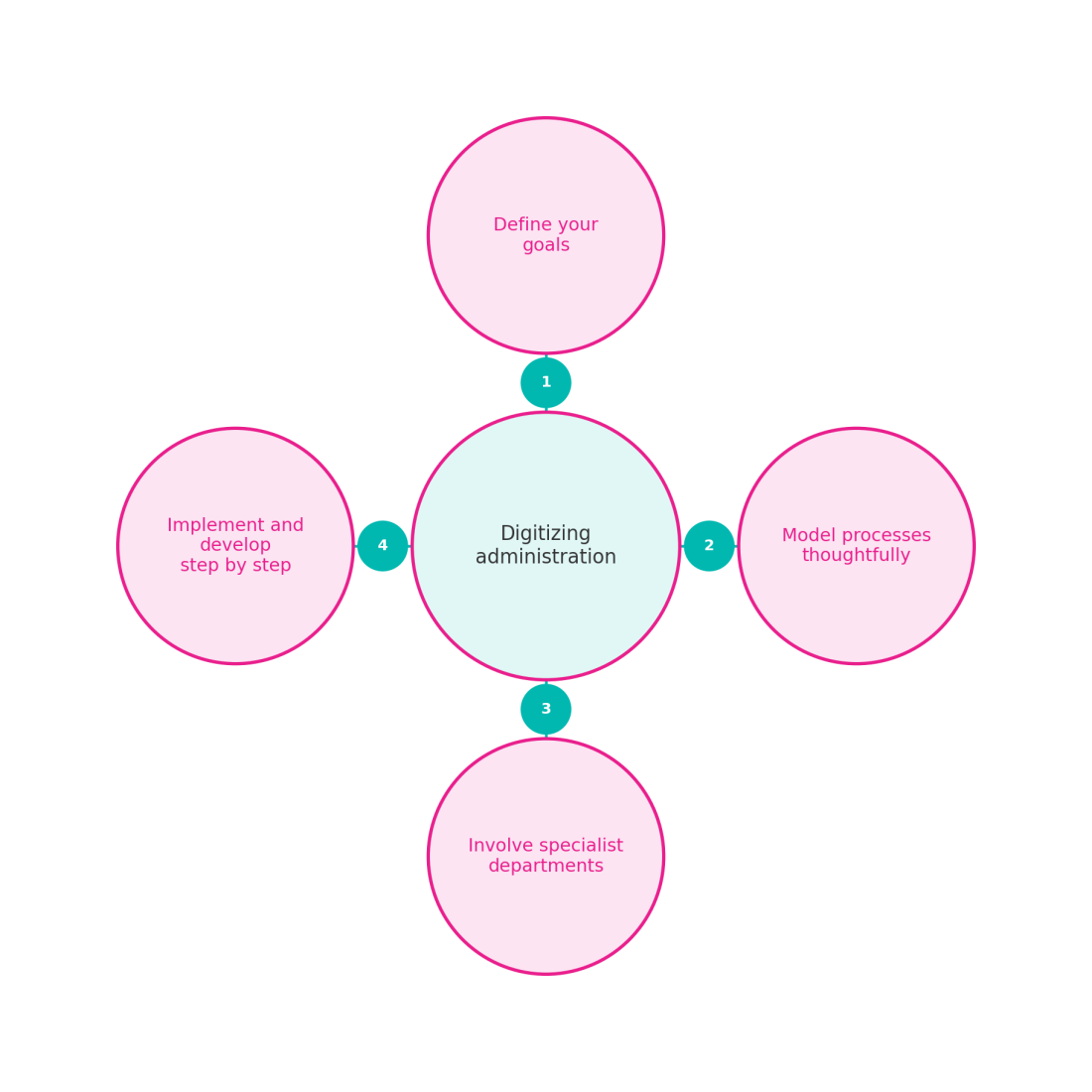
The path to digital administration need not be abstract or overwhelming. These four steps will help you get started:
Not every process needs to be digitised straight away. It makes sense to start with the processes that occur frequently, involve many people or require a great deal of coordination.
A common mistake is simply to replicate the existing disorganisation within processes in a digital format. Successful business digitalisation therefore means, above all, first structuring processes, scrutinising them critically and then implementing them digitally.
Digitalisation works best when the people who work with the process on a daily basis are involved. With linqi, specialist departments can help shape and model processes directly, rather than simply passing on requirements to other departments.
The best digitalisation strategy is rarely a massive one-off project. It usually makes more sense to start with a clearly defined use case, gain experience and build on that.
Specific examples illustrate how this works in practice.
Anyone looking for successful examples of digital transformation in businesses often thinks first of large-scale innovation projects. In reality, however, digitalisation usually begins much closer to everyday life.
Example 1: Digital application and approval processes
Holiday requests, procurement enquiries, invoice approvals and investment proposals are still among the classic time-wasters in many businesses. If these processes are digitised using linqi, requests can be recorded in a structured manner, automatically sent to the right departments and transparently documented.
Example 2: Systematically processing customer enquiries
Enquiries reach the company via email, telephone or various other contact channels. Without a clear structure, this leads to follow-up queries, gaps in information and unnecessary waiting times. Digital processes ensure that enquiries are recorded consistently, prioritised and forwarded to the relevant teams – with linqi, this happens as an automated workflow.
Example 3: Onboarding new employees
It is particularly during onboarding that new team members quickly realise whether a company operates digitally or is lagging behind. If access rights, documentation, training and coordination have to be organised manually, delays can quickly arise. Digitised workflows ensure that all steps are initiated at the right time. This means that linqi can also be used to organise the onboarding process in a structured and professional manner.
Example 4: Making documents and information centrally accessible
Many companies work with data that, whilst available, is scattered across different locations. Digitalisation prevents data silos and creates meaningful connections. Information is captured just once and then reused throughout the entire process. Thanks to its numerous interfaces and flexible integrations, linqi offers real added value here too.
Example 5: Mapping business processes without IT bottlenecks
A particularly practical example is the modelling of business processes directly within the relevant department. With a no-code platform such as linqi, companies can define and customise processes without having to initiate bespoke software development for every change. This speeds up projects and makes the digitalisation of businesses significantly more manageable.
A question that preoccupies many decision-makers: why does digital transformation fail within a company? The reasons are, of course, varied and specific to each case. One thing, however, can be said with certainty: often the problem lies not in a lack of motivation amongst staff, but in the wrong approach to the digitalisation strategy.
A common reason is that digitalisation is viewed merely as a tool. However, new software alone does not improve a process if responsibilities remain unclear, key information is missing or there are repeated media breaks.
It is equally problematic when companies think too big and take action too late. Anyone who tries to digitise everything at once will quickly lose track of the big picture. Clearly defined, practical projects with demonstrable benefits are more successful. These can be fine-tuned on an ongoing basis to find the optimal digitalisation strategy for your own company.
Another reason for failure is a lack of process clarity. A poor analogue workflow does not improve simply because it is suddenly carried out digitally. Genuine benefits only arise when processes are precisely defined, logically structured and sensibly managed.
Ultimately, of course, a lack of acceptance within teams also plays a role. If staff fail to recognise the added value or if new workflows are out of touch with their day-to-day reality, resistance and uncertainty arise. That is why digitalisation should not be planned over the heads of the specialist departments, but jointly within the team. A no-code solution such as linqi is the ideal approach for this.
One thing is certain: corporate digitalisation means far more than just digital documents or the purchase of new software. Rather, it is essential that companies understand, structure and sensibly redesign their processes in order to generate genuine added value from digitalisation – value that can be measured as a clear return on investment (ROI).
Digitalisation thrives on its close integration with business processes. When a solution addresses specific problems and is implemented step by step, it is accepted, used and valued. This is precisely what makes digital projects successful: not the biggest possible upheaval, but the well-thought-out improvement of day-to-day operations.
With linqi, processes can be digitised in such a way that forms, tasks, decisions, documents and interfaces interlock. This creates clarity, saves time and makes companies more adaptable.
After a preliminary discussion of approx. 30 minutes, we will automate your process free of charge and demonstrate linqi to you using your own process in a live demo via video call (approx. 60 minutes) to clarify any open questions.
Request Live-Demo