24.09.2026
Automating processes with AI: Step by step with linqi
Automating processes with AI: A simple step-by-step guide to automating your workflows with AI – using linqi as an example.

Business digitalisation involves transforming analogue or manual workflows into structured digital processes. The aim of this discipline is to capture information more quickly, automate repetitive tasks, reduce errors and make decisions based on better data. Key insight: Successful business digitalisation does not begin with the purchase of new software, but with a clear digitalisation strategy and a focus on the processes that really need to be improved in day-to-day operations. With linqi, it is possible to model precisely these processes in a practical way, manage them digitally and develop them flexibly.
In this way, digitalisation within organisations can therefore provide tangible help in becoming more flexible in the digital economy, thereby becoming a decisive competitive advantage. But what exactly is business digitalisation and how does it work?
How linqi digitalises processes
A simple definition of digitalisation is: digitalisation describes the conversion of analogue information, workflows or working methods into digital structures.
For linqi, however, this definition falls short. This is because corporate digitalisation means more than simply storing data digitally. Above all, it means rethinking existing processes. Information is no longer passed manually from one stage to the next, but is systematically recorded, checked, forwarded and documented.
The digitalisation of businesses thus lays the foundation for more efficient collaboration, better data quality and faster decision-making. An overview of the benefits highlights the enormous potential that digitalisation solutions such as linqi unlock within businesses.
A key benefit of business digitalisation is greater efficiency. Recurring workflows can be standardised, data does not need to be entered multiple times, and manual handover processes are eliminated. Instead of emails, Excel spreadsheets and follow-up enquiries, clear digital workflows are established. With linqi, businesses can then link their forms, approvals, tasks and documents in such a way that numerous individual steps are transformed into a structured overall process. Pure efficiency.
Digitalisation also demonstrates its strengths when it comes to interacting with customers, partners or internal enquirers. Information can be accessed more quickly, processes can be tracked accurately and responsibilities are clearly defined. The digitalisation of contact with customers and suppliers in small and medium-sized enterprises, for example, holds particular potential. With linqi, for example, incoming and processing workflows can be modelled in such a way that enquiries are not left unaddressed but are routed directly into the correct workflow.
Better decisions are not made solely on the basis of dashboards, but above all through reliable process data. When information is fully recorded, properly documented and available in the right place, it becomes much easier to evaluate processes, identify bottlenecks and set priorities correctly. Effective business digitalisation therefore creates a better foundation for decision-making – both operationally and strategically.
Another benefit of digitalisation lies not in greater control, but in greater clarity. Employees benefit in their day-to-day work when processes are clearly structured, information does not have to be hunted down, and recurring tasks are automated. With linqi, business units can help shape their own processes directly – without needing any special IT skills. This takes the pressure off teams, reduces the need for coordination and strengthens autonomy within the business units.
Digitalisation does not automatically save costs across the board, but it does reduce typical overheads: duplicate data entry, unnecessary loops, manual approvals, paper-based processes and error-prone handover procedures. Wherever many people are involved in a workflow, digitising these processes makes them more cost-effective. With linqi, this effect is particularly evident when numerous scattered individual steps are consolidated into a defined digital workflow.
Many companies do not grow not because there is a lack of demand, but because their internal processes fail to keep pace. Digitalisation resolves this bottleneck too: processes become more resilient and scalable. Of course, this does not automatically mean higher turnover, but it creates the conditions for growth: faster processing, higher process quality and a consistent workflow even as case numbers rise. This is precisely what makes business digitalisation a strategic issue and not merely a technical improvement.
Sustainability is also a benefit of digitalisation, though usually not as the primary driver, but rather as a consequence of digital processes. Less paper and a more targeted use of resources also have a positive environmental impact. When information is available digitally and processes mesh seamlessly, day-to-day work becomes not only more efficient but often more resource-efficient too.
A good digitalisation strategy does not start with the software, but with the process. Companies should first understand where friction arises in day-to-day work, which workflows are particularly prone to errors, and which steps are currently wasting time unnecessarily.
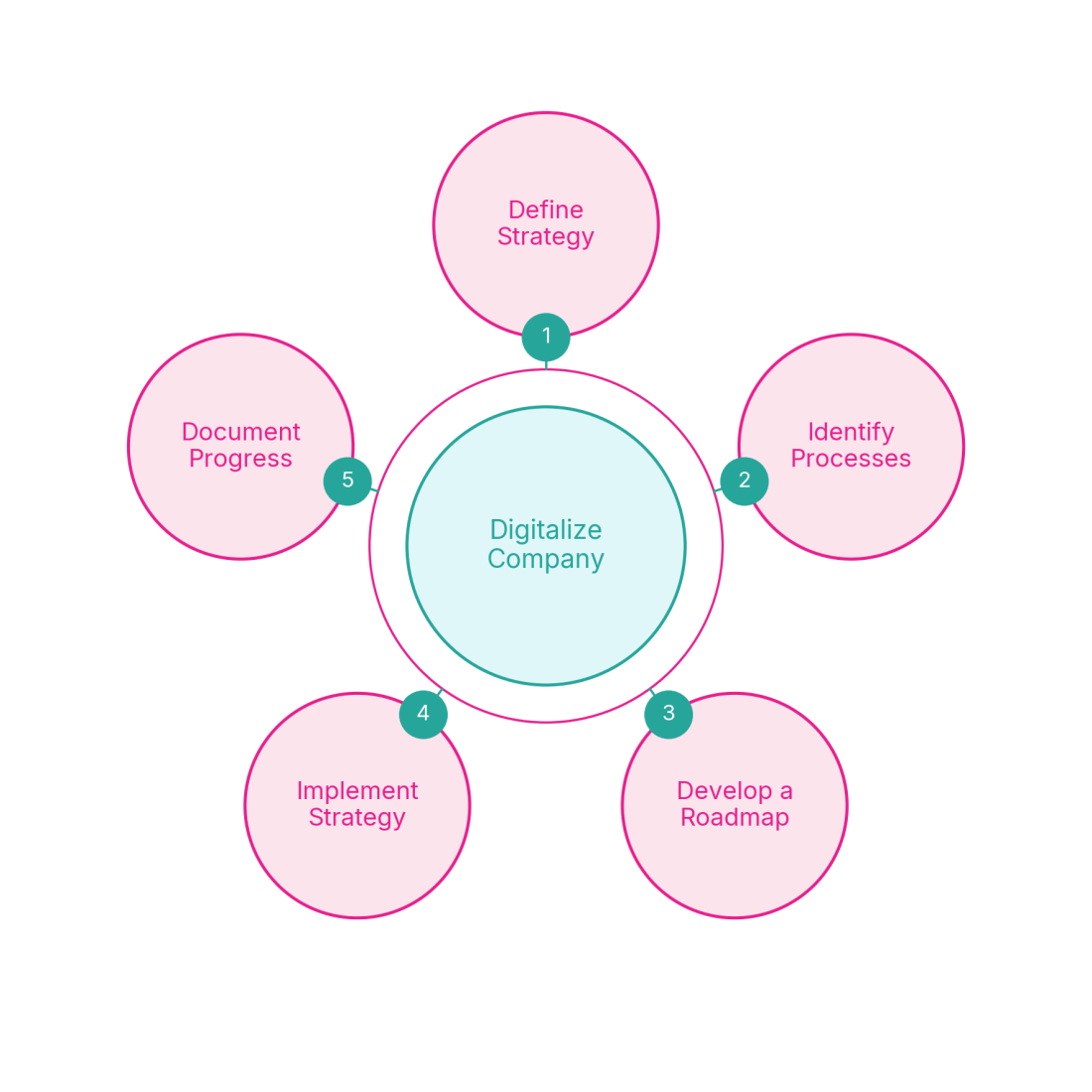
The first step is to ask what needs to be improved. Is it about faster processing times, greater transparency, lower error rates or better service quality? Only once the objective is clear can the right priorities be set.
Not every workflow needs to be digitised straight away. It makes sense to start with the processes that occur frequently, involve many people, or require a particularly high level of coordination.
A common mistake is simply to digitally replicate the existing disorganisation within the workflows. Successful business digitalisation therefore means, above all, first structuring processes, scrutinising them critically and then implementing them digitally.
Digitalisation works best when the people who work with the process on a daily basis are involved. With linqi, specialist departments can help shape and model processes directly, rather than simply passing on requirements to other departments.
The best digitalisation strategy is rarely a massive one-off project. It usually makes more sense to start with a clearly defined use case, gain experience and build on that.
Specific examples illustrate how this works in practice.
Anyone looking for successful examples of digital transformation in businesses often thinks first of large-scale innovation projects. In reality, however, digitalisation usually begins much closer to everyday life.
Example 1: Digital application and approval processes
Holiday requests, procurement enquiries, invoice approvals and investment proposals are still among the classic time-wasters in many organisations. If these processes are digitised using linqi, requests can be recorded in a structured manner, automatically sent to the right departments and transparently documented.
Example 2: Systematically processing customer enquiries
Enquiries reach the company via email, telephone or various other contact channels. Without a clear structure, this leads to follow-up queries, gaps in information and unnecessary waiting times. Digital processes ensure that enquiries are recorded consistently, prioritised and forwarded to the relevant teams – with linqi, this happens as an automated workflow.
Example 3: Onboarding new employees
It is particularly during onboarding that new team members quickly realise whether a company operates digitally or is lagging behind. If access rights, documentation, training and coordination have to be organised manually, delays can quickly arise. Digitised workflows ensure that all steps are initiated at the right time. This means that linqi can also be used to organise the onboarding process in a structured and professional manner.
Example 4: Making documents and information centrally accessible
Many companies work with data that, whilst available, is scattered across different locations. Digitalisation prevents data silos and creates meaningful connections. Information is captured just once and then reused throughout the entire process. Thanks to its numerous interfaces and flexible integrations, linqi offers real added value here too.
Example 5: Mapping business processes without IT bottlenecks
A particularly practical example is the modelling of business processes directly within the relevant department. With a no-code platform such as linqi, companies can define and adapt processes without having to initiate bespoke software development for every change. This speeds up projects and makes the digitalisation of businesses significantly more manageable.
linqi digitalises processes with these features
A question that preoccupies many decision-makers: why does digital transformation fail within a company? The reasons are, of course, varied and specific to each case. One thing, however, can be said with certainty: often the problem lies not in a lack of motivation among staff, but in the wrong approach to the digitalisation strategy.
A common reason is that digitalisation is viewed merely as a tool. However, new software alone does not improve a process if responsibilities remain unclear, important information is missing or there are repeated media breaks.
It is equally problematic when companies think too big and take action too late. Anyone who tries to digitise everything at once will quickly lose track of the big picture. Clearly defined, practical projects with demonstrable benefits are more successful. These can be fine-tuned on an ongoing basis to find the optimal digitalisation strategy for your own company.
Another reason for failure is a lack of process clarity. A poor analogue workflow does not improve simply because it is suddenly carried out digitally. Genuine benefits only arise when processes are precisely defined, logically structured and sensibly managed.
Ultimately, of course, a lack of acceptance within teams also plays a role. If staff fail to recognise the added value or if new workflows are out of touch with their day-to-day reality, resistance and uncertainty arise. That is why digitalisation should not be planned over the heads of the specialist departments, but jointly within the team. A no-code solution such as linqi is the ideal approach for this.
Successful digitalisation with linqi: view our case studies
One thing is certain: corporate digitalisation means far more than digital documents or the purchase of new software. Rather, it is essential that companies understand, structure and sensibly redesign their processes in order to generate genuine added value from digitalisation, which can be measured as a clear return on investment (ROI).
Digitalisation thrives on its close integration with business processes. When a solution tackles specific problems and is implemented step by step, it is accepted, used and valued. This is precisely what makes digital projects successful: not the biggest possible upheaval, but the well-thought-out improvement of day-to-day operations.
With linqi, processes can be digitised in such a way that forms, tasks, decisions, documents and interfaces interlock. This creates clarity, saves time and makes companies more adaptable.

After a preliminary discussion of approx. 30 minutes, we will automate your process free of charge and demonstrate linqi to you using your own process in a live demo via video call (approx. 60 minutes) to clarify any open questions.
Request Live-Demo