13.10.2026
Digital sovereignty in public administration: cloud versus on-premises – a comparison
Digital sovereignty for local authorities: cloud or on-premises – linqi offers both. Find out how the two models differ.

In a nutshell: When selecting software for process automation in public administration, several requirements are relevant. These can be broken down into four criteria: compatibility with the existing IT strategy; functional and technical requirements; one-off and ongoing costs; and interfaces and system integration. Added to this is the question of whether existing systems can be usefully supplemented. This aligns with the criteria established by the City of Aachen for selecting new software for the city administration. We will show whether and how linqi can meet these requirements for local authorities.
The aim of forward-looking local authorities and administrations is clear: administrative software should simplify workflows, reduce the workload on staff and drive forward the digitalisation of processes within the local authority. At the same time, it must fit into the authority’s established IT landscape and meet strict data protection requirements. Efficiency and the associated cost-effectiveness are also decisive factors in determining whether new software makes sense in public administration. So there are plenty of requirements – but how do cities and local authorities find the solution that suits them best?
Find out more about process automation in administration with linqi
The City of Aachen provides an insight into an effective selection process. In September 2026, it publicly set out the criteria against which new software purchases would be assessed. The selection is not based solely on functions or purchase price, but on a defined requirements profile. Let’s take a closer look at the criteria and examine them through the linqi lens.
When selecting new software, the City of Aachen first considers whether a solution meets the business and technical requirements as well as the existing IT strategy.
Key criteria include:
Firstly, the criteria highlight an important point: a piece of software may be functionally impressive yet still be the wrong solution. The decisive factor is whether it fits in with the specific processes within public administration and with the overarching IT strategy.
Before making a selection, therefore, a number of questions should be clarified: Which processes in public administration are to be digitised? Which requirements are absolutely essential? Which roles and permissions are required? Who needs to be involved in the selection process? Can the solution be extended to other departments and use cases at a later stage?
linqi demonstrates its strengths in terms of both technical and business requirements, as well as its capabilities for system integration. As a no-code platform, linqi is not limited to a single administrative process. Specialist procedures, approvals, application processes or internal workflows can be modelled using modular building blocks and adapted to new requirements – without having to develop new bespoke software for every process.
Can you already answer the key questions?
Then get started for free.
Cost-effectiveness is also a key factor in software evaluation. In Aachen, both one-off and ongoing costs are taken into account.
In short: focusing solely on the purchase price is not enough. Ongoing licence costs, maintenance and support, as well as the effort required for customisation and further development, are also relevant. Added to this are internal resources: how much IT capacity does the roll-out tie up? Do external service providers need to be brought in for every process change? And do additional costs arise if further use cases are to be digitised?
Particularly when it comes to the digitisation of city administration, it is therefore worth considering the long-term usability of a platform. To this end, linqi takes a no-code approach: staff in specialist departments can adapt and further develop automated processes themselves – without any programming knowledge and without having to bring in external development partners for every change. This reduces the ongoing effort required for customisation and supports the cost-effective operation of the automation software within the public authority. In addition, the linqi team is on hand to assist its customers with enhancements as required.
When selecting new software, the City of Aachen also considers compatibility with the existing IT architecture, existing specialist systems and interfaces. This is an important point, as local authority IT environments typically consist of numerous systems that are firmly integrated into administrative processes. This raises the question: Can the new software be integrated into the existing IT infrastructure?
To ensure this question can be answered with a clear ‘yes’, it is necessary to clarify which interfaces are available and how flexibly different applications can be connected. linqi offers the option of integrating existing specialist processes, DMS, e-files, portals, registers and other applications via interfaces and incorporating them into automated workflows. System integration with linqi enables data to be shared across systems.
One particularly interesting aspect of the Aachen Criteria concerns the question of whether new management software is actually required at all. This is because, before any research or selection takes place, an assessment is made as to whether the requirements might not be met by add-ons, modules or minor enhancements to existing solutions. Nobody wants siloed solutions. A uniform and standardised system landscape is therefore a priority.
The automation platform should therefore not only address a single use case, but serve as a common basis for various administrative processes. linqi supports system integration by integrating existing business processes, DMS, e-files, portals and other applications into automated workflows via interfaces. The no-code solution makes it possible to digitise and automate different processes on the same platform – acting as a central process control centre.
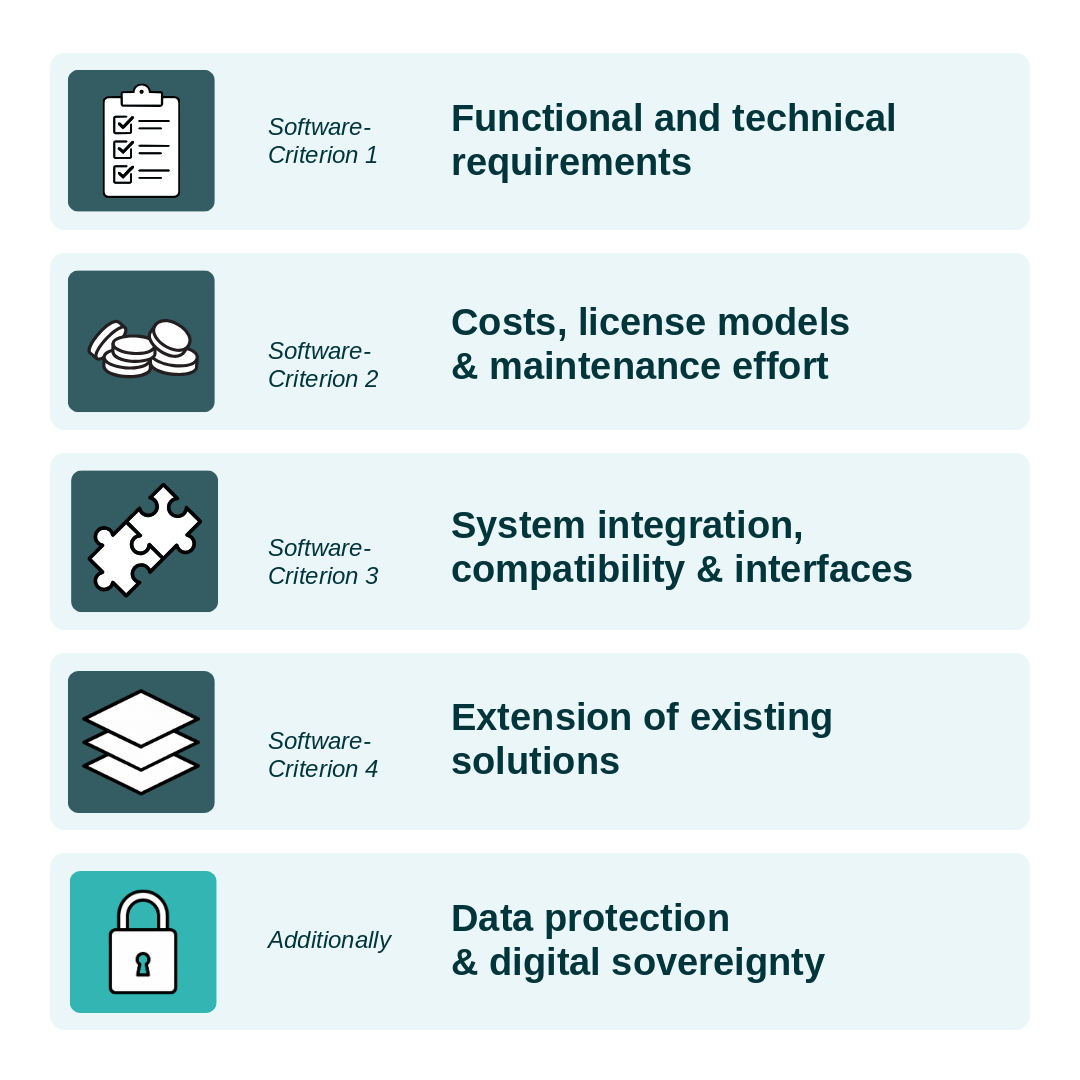
Beyond the criteria set by the City of Aachen, data security and digital sovereignty also play a role – a concept widely known as ‘municipal resilience’. This is because sensitive and personal data are frequently processed, particularly in administrative processes. This makes it all the more important, when selecting software, to consider where data is stored and processed, and which data protection and security standards the provider meets.
linqi is developed and operated in Germany. The platform is hosted exclusively in German data centres and is GDPR-compliant. Hosting takes place in ISO 27001-certified data centres. This ensures that data and its processing remain within Germany – an important consideration for public authorities that prioritise digital sovereignty as well as data protection and IT security.
The Aachen Criteria make it clear: the decision is not so much based on an extensive list of features. The key is to understand one’s own IT landscape and the processes that are to be optimised.
A suitable solution for process automation in public administration should therefore flexibly map business requirements, integrate existing systems via interfaces, support standardisation, be economically scalable, and incorporate data protection and IT security from the very beginning.
linqi is already in use in numerous public sector organisations – including Stadtwerke Herborn, the Hessen Police, the Baden-Württemberg Regional Finance Office and the Hessen Ministry of Agriculture and the Environment, Viticulture, Forestry, Hunting and Local Heritage. Examples such as these demonstrate how process automation with linqi can already be put into practice today in various areas of public administration.
After a preliminary discussion of approx. 30 minutes, we will automate your process free of charge and demonstrate linqi to you using your own process in a live demo via video call (approx. 60 minutes) to clarify any open questions.
Request Live-Demo