
Contents

In a nutshell: Digital sovereignty means that public authorities can decide for themselves which software to use, where their data is processed, and to what extent they are dependent on which providers. With linqi, businesses, organisations and local authorities can automate their administrative processes, choosing between a cloud solution hosted in Germany and running the system on their own infrastructure – in other words, on-premises. Which option makes more sense depends on the technical requirements, available resources and security specifications of the organisation in question. Let’s take a look at these below.

What does digital sovereignty mean in public administration?

Digital sovereignty describes the ability to design and control one’s own IT systems, data and digital processes independently. This also includes being able to switch software providers without bringing key administrative processes to a halt.

In practice, digital sovereignty usually affects several areas:

  • Data sovereignty: The administration knows exactly where its data is stored and processed, and who is authorised to access it.
  • Technological independence: Software solutions can be operated, as far as possible, without unnecessary dependencies on individual manufacturers.
  • Interoperability: Existing specialist systems and new applications can communicate with one another via suitable interfaces.
  • Operational freedom: The public sector can decide whether an application is run in the cloud or on its own infrastructure.
  • Long-term operational flexibility: Changes to prices, licensing models or technical conditions do not automatically mean that existing processes have to be rebuilt.

With linqi, this approach is demonstrated, amongst other things, by the fact that the process management software can be connected to existing business processes via interfaces. To this end, linqi offers, amongst other things, API interfaces, webhooks and various connectors through which existing business processes, databases and other applications can be linked together. This enables local authorities to automate their processes without having to replace their existing system landscape. Handy, isn’t it?

Why is digital sovereignty becoming increasingly important – particularly for local authorities?

In light of increasing geopolitical tensions, growing cyber threats and the risks posed by dependence on individual software providers, digital sovereignty is becoming increasingly important, particularly for public administrations. They want to retain long-term control over their data, IT systems and administrative processes. Increasingly, (public) administrations are rightly asking themselves: what actually happens if a key software provider suddenly becomes unavailable? For many German administrations, this would not only be an IT problem, but would likely, sooner or later, disrupt the entire running of the administration.

With linqi, for example, local authorities have access to a process automation solution that allows them to decide for themselves whether they wish to run the software in the cloud or on their own IT infrastructure. But of course, this is not the case with every software solution.

A recent report by Tagesschau highlights just how heavily local authorities have come to rely on individual software manufacturers. Among other things, it focuses on the town of Nettetal in North Rhine-Westphalia, which is increasingly concerned about its dependence on US software companies.

The concern is that, should certain Microsoft services no longer be available for political or legal reasons, it might not just be Word, Excel or PowerPoint that are affected. Numerous specialist municipal systems could also fail because they are technically reliant on the relevant Microsoft systems.

A survey by the Municipal Joint Office for Administrative Management (KGSt), which is in the possession of WDR, shows that this is not an isolated problem:

  • Almost 92 per cent of the local authorities surveyed in North Rhine-Westphalia state that they are dependent on software and cloud providers.
  • 82 per cent regard this dependence as critical.

These figures illustrate why cities, local authorities and public bodies in particular are increasingly looking into alternative software solutions.

The key aim here is to set up their own IT infrastructure in such a way that an administration remains capable of functioning and is not entirely dependent on individual manufacturers.

Get free advice on digital sovereignty

On-premises vs. cloud: what’s the difference?

When selecting process management software, the question of the operating model inevitably arises sooner or later. Should the application run on in-house servers or be provided via a cloud provider? And which is the better solution for public sector organisations? linqi’s experience shows that there is no one-size-fits-all answer to this question. Both options can be suitable for public authorities. However, they differ in terms of control, maintenance, infrastructure and organisational effort.

Option #1: On-premises – running software on your own infrastructure

With an on-premises solution, the software is run on servers managed either by the organisation itself or by a contracted local authority IT service provider.

The organisation therefore largely determines for itself how the technical environment is set up, which security measures apply and how access to the systems is managed. This provides a significant degree of autonomy.

On-premises operation is particularly suitable for local authorities that already have their own data centres or appropriate IT service providers. On-premises solutions can also offer advantages in cases involving specific security requirements, complex specialist process landscapes or limited external network connectivity.

However, this operating model entails a certain degree of responsibility. Servers must be maintained, updates installed, security measures implemented and sufficient capacity provided. This requires the relevant IT expertise or a reliable operational partner.

Option #2: Cloud – Using software without your own server infrastructure

With a cloud solution, the software is hosted in an external data centre and is usually accessed via a browser or a dedicated application. This means that the administration does not need to set up its own server environment for the application.

In a Software-as-a-Service (SaaS) model, the provider usually takes care of technical operations, maintenance and the provision of updates. linqi can also be used as a SaaS solution. The software is hosted in German data centres, enabling local authorities to automate their administrative processes without having to operate their own server infrastructure.

This can be particularly beneficial for smaller local authorities whose IT departments are already working at full capacity. Even when an application needs to be rolled out quickly or made available flexibly to additional departments, the cloud often offers organisational advantages.

Choosing the right provider is crucial. For many towns and local authorities, a German cloud or hosting in Germany is a key component of digital sovereignty in terms of data location. linqi therefore bases its cloud solution on hosting in German data centres with an ISO 27001-certified data centre environment and attaches great importance to data protection and IT security. However, for the legal and technical assessment, access rights, subcontractors, potential transfers to third countries and the actual security measures must also be taken into account.

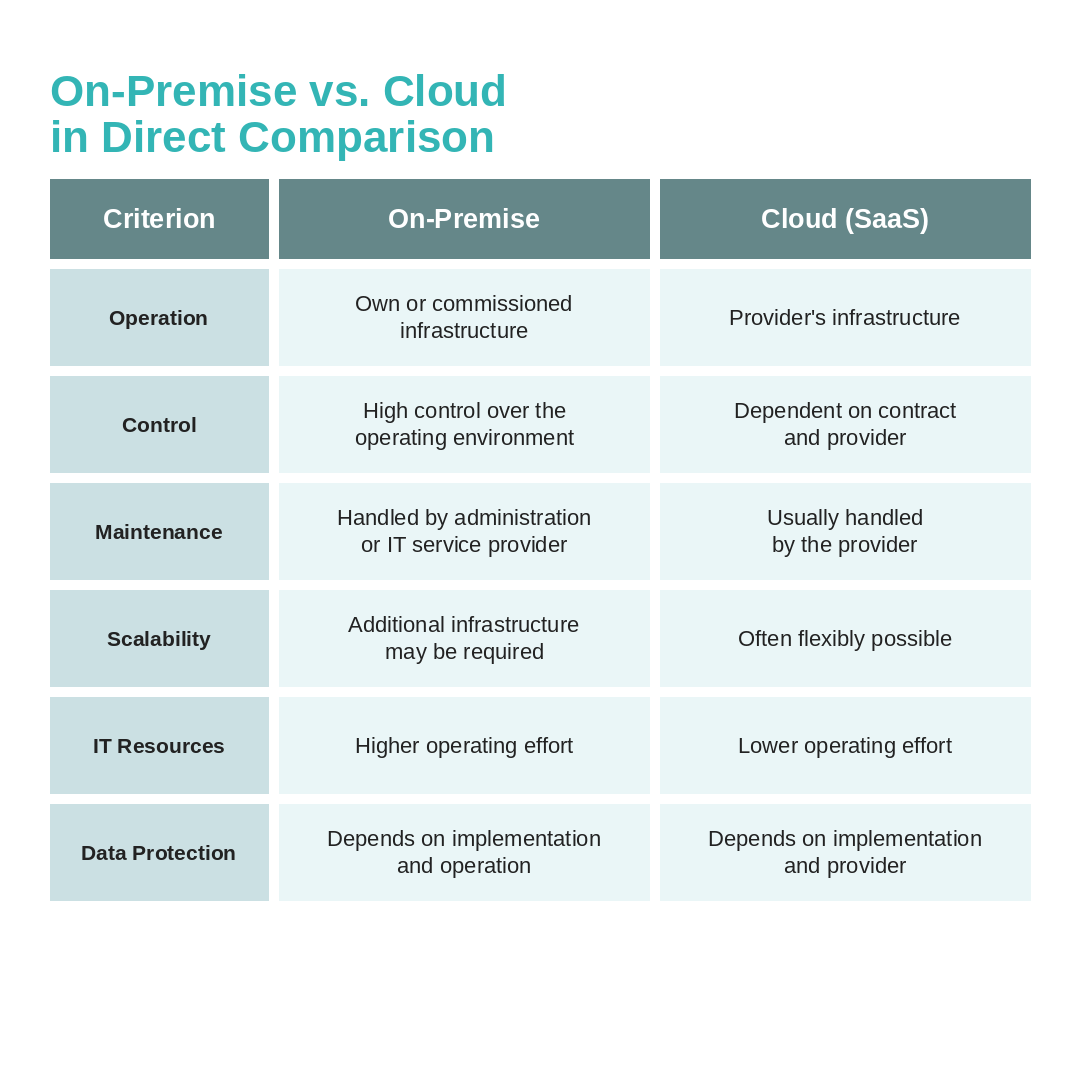
A direct comparison: on-premises vs. cloud

The overview compares the two operating models – on-premises and cloud – across six specific categories.

Find out which model suits your specific circumstances during a free live demo

Why the freedom to choose an operating model is so important

Anyone introducing new municipal administration software today is making a decision that will last for many years. It is therefore all the more important that the chosen solution is not only functionally sound, but also fits in with the long-term IT strategy and is compatible with existing structures.

Take this example: a local authority has so far relied predominantly on cloud applications but wishes to run certain sensitive processes in its own data centre in future. If its process automation is available exclusively as a cloud service, switching software is often the inevitable consequence.

The option to choose between on-premises and cloud – as is the case with linqi – provides greater flexibility. It makes it easier to take different security requirements into account and to integrate the software into existing IT structures.

Of course, the choice between cloud and on-premises alone does not guarantee complete digital sovereignty. Interfaces, data exports, licence terms and the technical architecture also play a role. But the freedom to choose the operating environment is a crucial part of this. linqi further supports this flexibility through a no-code process designer, which allows administrative workflows to be adapted to new requirements, as well as an OpenData Policy that enables the export of customers’ own data. Let’s take a closer look.

Digital sovereignty with linqi: process automation in the cloud or on-premise

With linqi, local authorities do not have to commit to a specific operating model. The process management software from Bonn therefore offers public sector organisations a flexible way to digitise and automate their processes without necessarily having to make fundamental changes to their existing IT infrastructure.

linqi in the cloud, hosted in Germany

Users of linqi as a cloud solution benefit from the security of having the service operated in German data centres. Hosting takes place in an ISO 27001-certified data centre environment. In addition, linqi utilises geographically separate data centres and intrusion detection to identify potential attacks at an early stage. Since June 2026, linqi has also been authorised as a CVE Numbering Authority (CNA) and can uniquely record and document security vulnerabilities within its own area of responsibility. Furthermore, linqi ensures additional data security through backups and recovery procedures.

This can be an attractive option, particularly for public authorities without their own extensive server infrastructure, enabling them to introduce digital processes with manageable technical operational costs.

linqi as an on-premises solution for existing IT infrastructure

Local authorities that prefer to run their software themselves can deploy linqi on their own infrastructure.

The on-premises version supports both Linux and Windows Server. For the database, local authorities can choose between PostgreSQL and Microsoft SQL Server. This allows the software to be adapted to different technical environments.

Case study: Digital sovereignty in a local authority using linqi

Suppose a local authority wishes to digitise its internal approval processes. At present, applications are sent by email, responsibilities are checked manually and approvals are documented in various systems.

With linqi, the council could organise this workflow using digital forms, automatic task allocation and predefined approval steps.

If the local authority already operates its own data centre, it can opt for the on-premises version. A smaller local authority without the necessary IT capacity could implement the same use case using the cloud solution.

In both cases, process automation pursues the same goal: less manual work, clearer responsibilities and traceable workflows.

Request a live demo now

What should local authorities look out for when selecting reliable administrative software?

Whether it’s traditional administration software, a new automation platform or software for local government: anyone looking to use a solution in the long term should not simply compare the range of functions.

Selection criteria for robust administration software:

  • Operating model: Is the software available exclusively as a cloud service, or can it also be deployed on-premises?
  • Data location: Where is data stored, processed and backed up?
  • Interfaces: Can existing specialist processes and other applications be integrated?
  • Technological dependencies: What external services does the software require to operate?
  • Data protection and security: What evidence, protective measures and contractual provisions does the manufacturer provide?
  • Long-term flexibility: Can data be exported, processes adapted and technical requirements modified?

Conclusion: Digital sovereignty starts with the choice of software

The debate surrounding the dependence of German public authorities on international technology conglomerates highlights just how important it has become to make IT decisions that are sustainable in the long term.

Above all, digital sovereignty means consciously assessing one’s own dependencies, creating alternatives and retaining control over key processes – this applies equally to public administrations, businesses and other organisations.

With linqi, local authorities can automate their processes whilst deciding for themselves whether to run the software in the cloud or on-premises.

After all, good software should adapt to the requirements of the local authority – not the other way round.

FAQ: Frequently asked questions about digital sovereignty in public administration

Request a free live demo

After a preliminary discussion of approx. 30 minutes, we will automate your process free of charge and demonstrate linqi to you using your own process in a live demo via video call (approx. 60 minutes) to clarify any open questions.

Request Live-Demo

More Posts

Datenschutz und Digitalisierung
01.10.2026
Digitalisation: Does data protection slow down innovation? Not with linqi.

Data protection does not need to slow down innovation. Find out how businesses and public sector organisations use linqi to automate processes securely, in compliance with data protection regulations and efficiently.

Digitalisation: Does data protection slow down innovation? Not with linqi.