15.10.2026
Hessian Ministry introduces the linqi wildlife management system
With linqi, the Hessian Ministry of Agriculture and the Environment has created a digital reporting system for wild boars found dead.
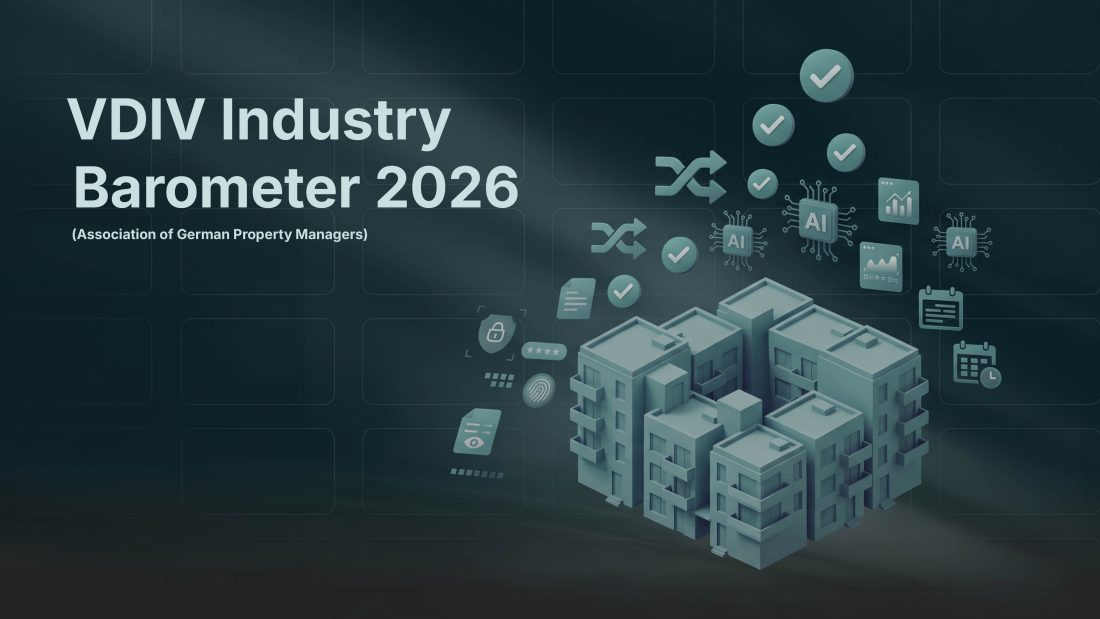
Bonn, 7 September 2026 – Increasing demands, a shortage of skilled staff and costs that are difficult to estimate are pushing many property management firms to their limits. This is shown by the latest 2026 Industry Barometer from the Association of German Property Managers (VDIV). 62.1 per cent of the companies surveyed stated that they were overburdened. But help is at hand – in the form of digitalisation. The logical conclusion drawn from the industry barometer is that where staff capacity is lacking, existing processes must be made simpler and more efficient – for example, with linqi.
More than half of property management firms are unable to fill vacant posts. This is particularly problematic because the workload in day-to-day operations can fluctuate unpredictably. 64.7 per cent of respondents cite the difficulty in planning the time required per property as one of the biggest challenges, whilst 38.2 per cent point to unforeseeable additional tasks.
The consequences of this heavy workload are increasingly evident in the selection of properties under management. 57.1 per cent of companies intend to divest themselves of particularly time-consuming properties in future. 49.5 per cent even plan to hand over unprofitable mandates where the workload and remuneration are no longer in a commercially viable balance. At the same time, many property management firms must assess how the rising workload can still be justified financially.
It is therefore essential to utilise existing capacities as efficiently as possible – and a clear trend is emerging in this regard.
The industry barometer shows that property management firms are ready for a shift. 70.3 per cent cite digitalisation as their top business priority. 77 per cent want to automate their internal processes. Artificial intelligence is also becoming increasingly important: 60.8 per cent plan to expand their existing use of AI, whilst a further 24.9 per cent intend to use AI for the first time. Just how established this trend already is is illustrated by the development of new industry-specific AI assistants, which are being developed specifically for property management firms to take on individual tasks. linqi, on the other hand, functions as a broad-based, flexible platform for process automation, enabling the digital mapping, integration and automation of property management firms’ individual workflows – with optional AI integration.
It is therefore clear that the crucial step lies in utilising the possibilities of digitalisation in such a way that they actually ease the workload in day-to-day operations. In property management firms, there are numerous processes in which information is gathered via emails, documents and various systems and then passed on manually. These include, for example, defect reports, approvals, handover processes, documentation and the processing of security deposits.
As a no-code platform, linqi offers functions that can be used for numerous processes in property management. With linqi, recurring processes can be mapped out as digital workflows and automated – without any programming. Forms, tasks, responsibilities, documents, approvals and further processing steps are linked together in an end-to-end process.
A defect report, for example, can be recorded in a structured manner, automatically assigned to the responsible person and then documented in a traceable way until the issue is resolved. This means that information no longer needs to be forwarded manually between the various parties involved. Particularly important for a seamless workflow: linqi can be connected to any third-party systems via interfaces, thereby complementing existing digital structures and utilising data across different systems.
The VDIV Industry Barometer shows that digitalisation in the property sector is a strategic decision. The efficiency of internal processes is undoubtedly becoming a decisive factor.
Of course, process automation does not solve the shortage of skilled workers. However, it can help relieve the existing team of repetitive manual tasks, allowing staff to devote their working hours to areas where human expertise and personal communication are required.

If you are interested, please feel free to contact us!
After a preliminary discussion of approx. 30 minutes, we will automate your process free of charge and demonstrate linqi to you using your own process in a live demo via video call (approx. 60 minutes) to clarify any open questions.
Request Live-Demo