

An API connects different programmes to one another. It ensures that data can be automatically transferred from one tool to another, where it can then be processed further – for example, in digital administrative processes.
We want to enable companies to focus on value-adding activities through self-directed automation, because nobody knows their own processes as well as they do themselves.)
Staff shortages are a problem in almost all companies. The healthcare sector, the logistics industry, the skilled trades and the hospitality sector are particularly affected, but companies in the IT sector have also been struggling for years to fill their vacancies with qualified specialists.
Positioning oneself as an attractive employer can solve the problem for individual companies, but the fact remains: If there are fewer skilled workers than there are vacancies, some positions will inevitably remain unfilled. A more effective solution is to deploy your own skilled staff exactly where they are needed – and to automate repetitive day-to-day tasks.
McKinsey estimates that around 30 per cent of all tasks across approximately 60 per cent of all fields of work could be automated. This would free up a great deal of time and capacity for your staff, which they could then use for value-adding activities. But how can process automation be implemented?
Process automation with linqi
linqi is a no-code software solution that helps companies easily digitise and automate their business processes. ‘No-code’ means that anyone can use the software via an intuitive, visual interface – without any specialist IT knowledge. Nevertheless, linqi offers the flexibility to map out all individual business processes: the software adapts to your business, not the other way round.
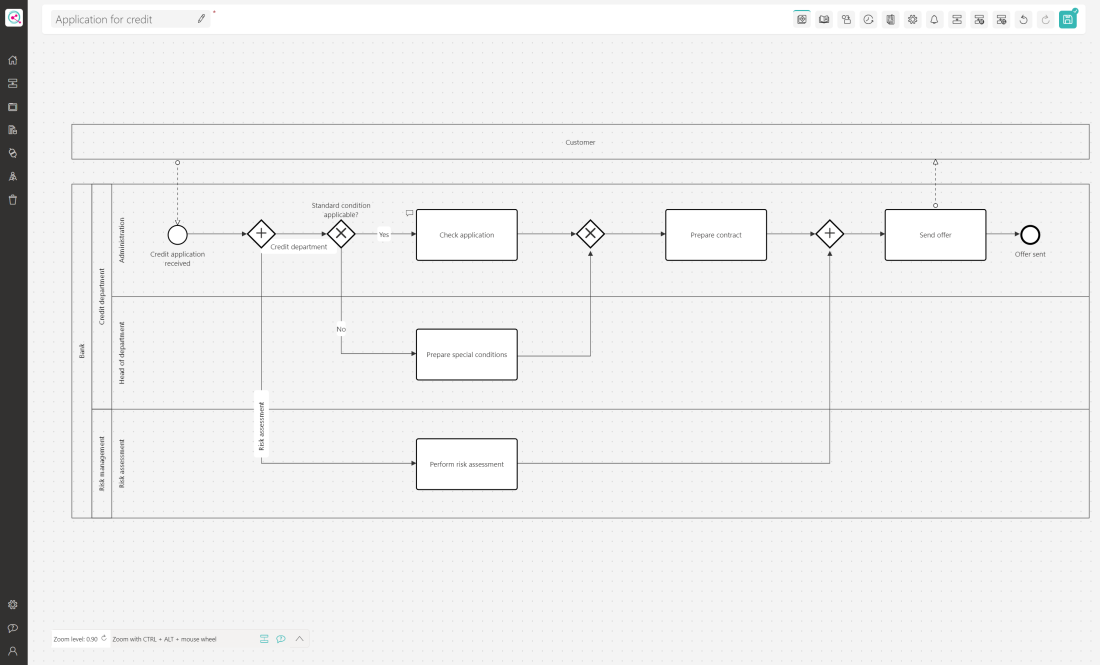
BPMN 2.0 process representation
In the graphical process designer, all processes can be represented using BPMN 2.0 symbols. New processes can also be modelled and tested.
Integration with third-party systems
linqi can be integrated with almost all common third-party systems, whether these are calendar programmes, CRM systems or other software used by your company.
Custom forms
The graphical form designer allows you to flexibly create digital forms that simplify your document management and data flow within the organisation.
Which processes can be automated using linqi?
linqi can automate numerous process steps, from data transfers and documentation right through to financial control, allowing staff to focus on value-adding activities. Typical time-consuming tasks in business processes that can be reduced with linqi include:
- The manual coordination of the staff involved
Let’s take the recruitment process as an example: an application comes in and is reviewed by a member of staff in the HR department. If it’s a good application, this staff member manually forwards it to the line manager, who also reviews it. It takes several days for HR to receive feedback from the line manager. Then, a date for an interview has to be laboriously coordinated – usually involving 3–4 emails being sent back and forth. This takes a great deal of time – especially when there is more than one application to deal with. In linqi, everyone involved has immediate access to the application; it is properly filed, and appointments can be coordinated automatically via a calendar integration. - Manual data maintenance
Whether it’s applicant information, customer details, stock levels or other data – if you maintain it manually in Excel or another programme, it takes an incredible amount of time and is also prone to errors. linqi ensures that data from applications, orders and so on is automatically transferred and updated. Automated data flows are a huge advantage, particularly in order processing. When an order comes in, stock levels and transport capacity can be checked and adjusted immediately. If the order causes stock levels to fall below a threshold, the production process can be triggered straight away – this creates a lean, cross-departmental system completely free of manual hurdles. - Manual document management
Where on earth is that contract the former employee signed seven years ago? And where is that document someone left on my desk three days ago for me to sign? Manual document management is usually a mess of loose sheets of paper waiting to be sorted and overcrowded filing cabinets that nobody can really find their way around. With linqi, all documents can be digitised in a matter of seconds and stored in the right place. This means they can still be found quickly, even years later, with a simple search. - Lack of documentation
For processes and workflows to run efficiently, all the necessary information must be easily accessible. This also means that all key information must be documented during a process. If this doesn’t happen, staff spend a lot of time searching for or asking for this information. In linqi, processes are automatically documented, with all information available centrally within the system.
This not only saves employees time, but also makes the processes themselves more transparent – the first step towards improving them in the long term.
Automation software as a solution to staff shortages: these are the key benefits
Process automation is not about making staff redundant. It is about helping them do their jobs better. Almost everyone spends a large part of their working day on time-consuming or monotonous tasks that do not create any real added value. This time is then lacking for the truly value-adding, strategic or creative tasks that drive the business forward. By automating simple tasks:
- Employees can devote themselves to value-adding activities without interruption.
- Employees can carry out their tasks more quickly and effectively.
- Employees can thrive in a structured working environment and finally see real results.
Furthermore, digitalisation and automation also make your company a more attractive place to work. At the same time, more efficient, improved processes also provide a decisive competitive advantage, as you can offer a better experience not only to your own staff but also to your customers – without having to expand your team at all.
Request a free live demo
After a preliminary discussion of approx. 30 minutes, we will automate your process free of charge and demonstrate linqi to you using your own process in a live demo via video call (approx. 60 minutes) to clarify any open questions.
Request Live-Demo